
Ventall: from legacy HVAC website to an AI-ready visibility and demand qualification system
IndexDock rebuilt Ventall from a WordPress site with 0% schema coverage and 10% Share of Answer into a system AI search and crawlers can read.
By Oleksii Predachenko · Founder
Technical AI Readiness
A legacy WordPress site, almost invisible to search and AI. Models can't read the business entity or its answers.
Technical AI Readiness
Rebuilt on Next.js into an AI-readable system — search, AI answers and crawlers can now understand the business.
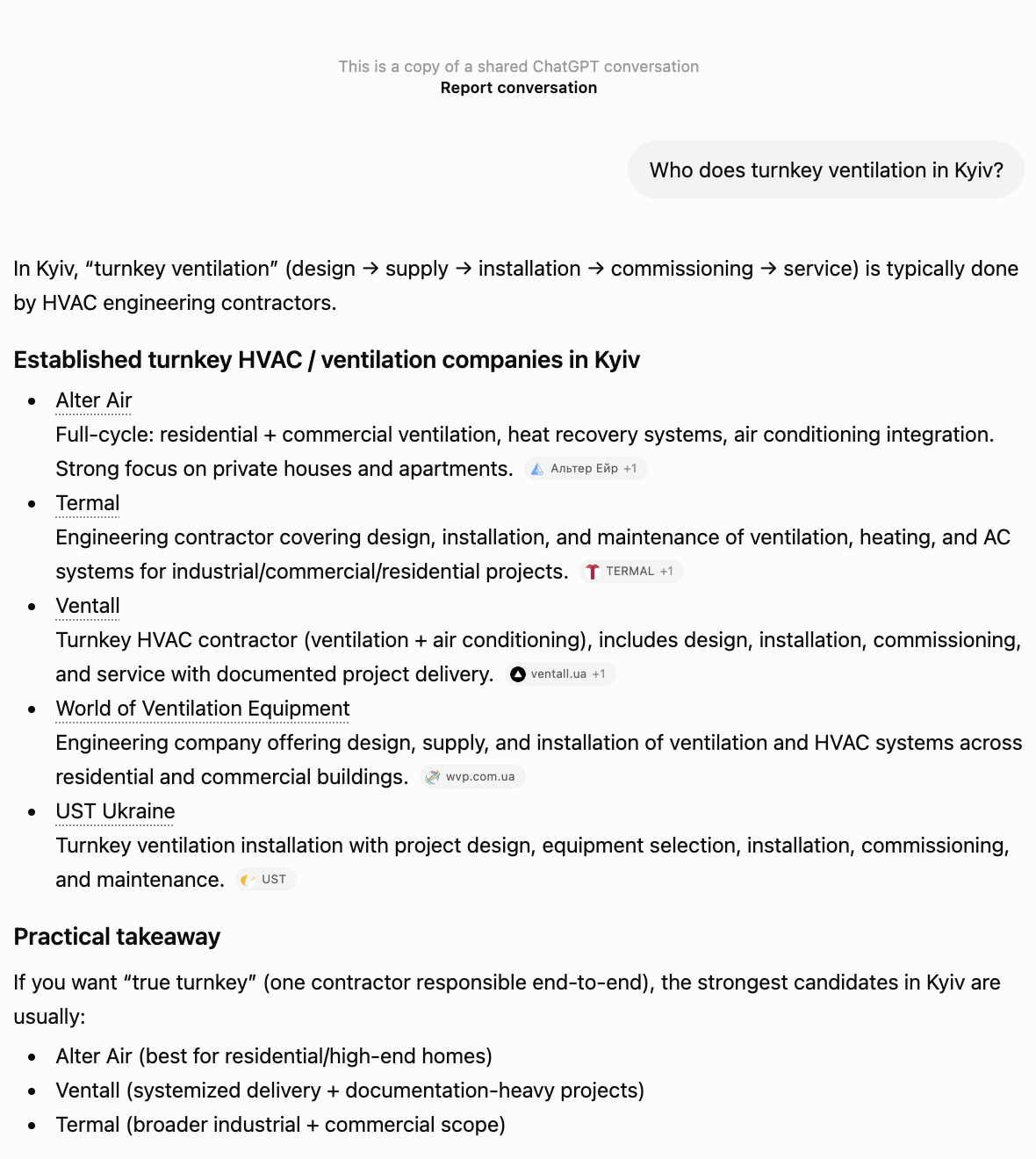
How AI answers now — live citations
ChatGPT · data as of June 2026
Ventall already had real HVAC projects: ventilation and air conditioning for apartments, houses, and commercial properties. But the legacy WordPress site worked like a brochure: the business entity, services, answers, and navigation context were almost invisible to AI/search. Requests arrived without structure, preliminary estimates could take days, and the team spent expert time on manual clarification.
IndexDock rebuilt this into a production-ready visibility system. The new site gives Ventall an AI-readable business foundation, structured service architecture, answer-ready content, real proof through cases, and a pricing calculator that qualifies requests before the first conversation. Customers now get preliminary pricing direction in minutes, AI/search can correctly read the business, and the team works with qualified data instead of raw requests.
Ventall (HVAC engineering, Ukraine) is a company within the same group as IndexDock. That is why we show this case openly, with full access to the data and results behind it.
What changed
From invisible business to AI-readable entity
Before
The old site had basic SEO, but no machine-readable business foundation: 0% JSON-LD/schema coverage, no Organization, LocalBusiness, Service, FAQPage, HowTo, or Breadcrumbs. AI/search could not reliably understand who Ventall was or what the company offered.
After
Ventall now has an AI-readable foundation: the business entity, services, FAQ, HowTo content, navigation context, and local business signals can be understood by search engines, AI search, and crawlers.
From service list to premium delivery system
Before
The website described isolated services: ventilation, air conditioning, installation, and equipment. This made the offer look like a list of tasks and did not explain why a full HVAC solution can justify a higher-value project.
After
Ventall is now presented as a complete HVAC delivery cycle: consulting, design, supply, installation, commissioning, and service. This supports premium positioning and explains the value of the integrated approach.
From raw leads to qualified demand
Before
Requests arrived raw: "I need ventilation." The team had to manually clarify object type, area, system choice, scenario, complexity, and budget direction.
After
Requests now arrive with context: object type, area, rooms/zones, system choice, and scenario are captured before the first conversation. The team receives a qualified commercial signal, not just a contact form.
From slow estimate cycle to pricing direction in minutes
Before
A preliminary estimate could take days, especially when the starting data was incomplete. Customers waited while managers and engineers spent expert time on clarification.
After
The pricing calculator gives customers preliminary budget direction in minutes. The team starts from structured data instead of manual discovery.
From portfolio content to proof and answer layer
Before
Cases, articles, and answers existed as separate content pieces, but they did not work as one system for trust, explanation, and AI/search understanding.
After
Cases now work as the proof layer, FAQ and articles as the answer layer, and video/documents as trust assets. This helps both people and AI/search understand Ventall's experience, scenarios, services, and evidence.
From one-time website to controlled visibility foundation
Before
There was no clear foundation for control: it was hard to understand which requests were qualified, how visibility was changing, or where the system needed improvement.
After
Ventall now has a controlled visibility foundation: structured intake, measurable pricing flow, AI/search readiness signals, and a basis for ongoing monitoring and improvement.
What IndexDock delivered
Blueprint and visibility strategy
A strategic foundation that turned Ventall’s business, services, demand, and answer structure into a clear AI/search visibility system.
Production implementation
A React / Next.js rebuild with localized uk/en structure, new routing, service pages, cases, articles, FAQ, and conversion paths.
Pricing qualification
A guided pricing flow that captures key project context before the first conversation with the team.
AI discovery foundation
A machine-readable foundation so Google, AI search, and crawlers can correctly read the business, its services, and its answers.
Trust and proof layer
Cases, real project evidence, media, documents, and answer content supporting high-value HVAC decisions.
Control foundation
A controlled visibility foundation with structured intake, measurable pricing flow, AI/search readiness signals, and a basis for ongoing monitoring and improvement.
01 Visibility
AI and search can now read the business
The old site had services and content, but the business itself was almost invisible to AI and search — there was no machine-readable foundation connecting who Ventall is, what it offers, and the proof behind it.
IndexDock rebuilt Ventall on an AI-readable foundation. The business, its services, answers, and local context can now be understood by Google, AI search, and crawlers — and Ventall is cited by name for turnkey HVAC queries in Kyiv.
Key value
02 Qualified demand
Requests now arrive qualified, not raw
Before, requests came in as "I need ventilation," and the team spent days clarifying object type, area, system choice, and budget direction before any real conversation.
A guided pricing flow now captures the key project context up front. The team receives a qualified commercial signal with prepared data — instead of raw messages that consume expert time.
Key value
03 Speed to value
Pricing direction in minutes, not days
A preliminary estimate could previously take days when the starting data was incomplete, with customers waiting while experts clarified the basics.
Customers now get preliminary budget direction in minutes, and the team starts from structured data instead of manual discovery.
Key value
04 Control
A controlled foundation, stable after launch
The move from the legacy site to the new system was handled as a controlled release, so Ventall kept its accumulated search signals and launched on a stable footing.
Launch was not the endpoint: the system is measurable and improvable, so the team can see where to correct instead of guessing — across request quality, pricing flow, visibility, and stability over time.
Key value
Need a next step beyond reading?
Start with an AI Discovery Screening, or contact IndexDock if you already know your site needs a structured visibility system.